The idea in brief
Muslims believe the Qur’an has been preserved exactly as revealed. Historically it was transmitted through memorisation and writing during the Prophet’s lifetime, collected into a single volume soon after his death, and standardised under the caliph Uthman. Today it is read from one consonantal text and recited in a small number of recognised readings.
A recited book
The word Qur’an means recitation. The revelation was delivered orally, memorised by the Prophet’s companions, and recited in daily prayer. Writing accompanied this from the start: companions recorded passages on parchment, leather, bone, and palm stalks as they were revealed.
This dual transmission, oral and written, is central to the Muslim understanding of preservation. Qur’an 15:9 states that God Himself guards the Reminder; Muslims read this as a promise fulfilled through the community that memorised and transmitted it.
Collection after the Prophet
After the Prophet’s death in 632, and following the death of many memorisers in battle, the first caliph Abu Bakr commissioned Zayd ibn Thabit, a scribe of the Prophet, to gather the written records into one collection, checked against the memory of the companions.
Around 650 the third caliph, Uthman, had standard copies made from this collection and sent to the major cities, with instructions that other written variants be withdrawn. This established a single consonantal text, the Uthmanic codex, used by Sunni and Shia Muslims alike.
Early manuscripts
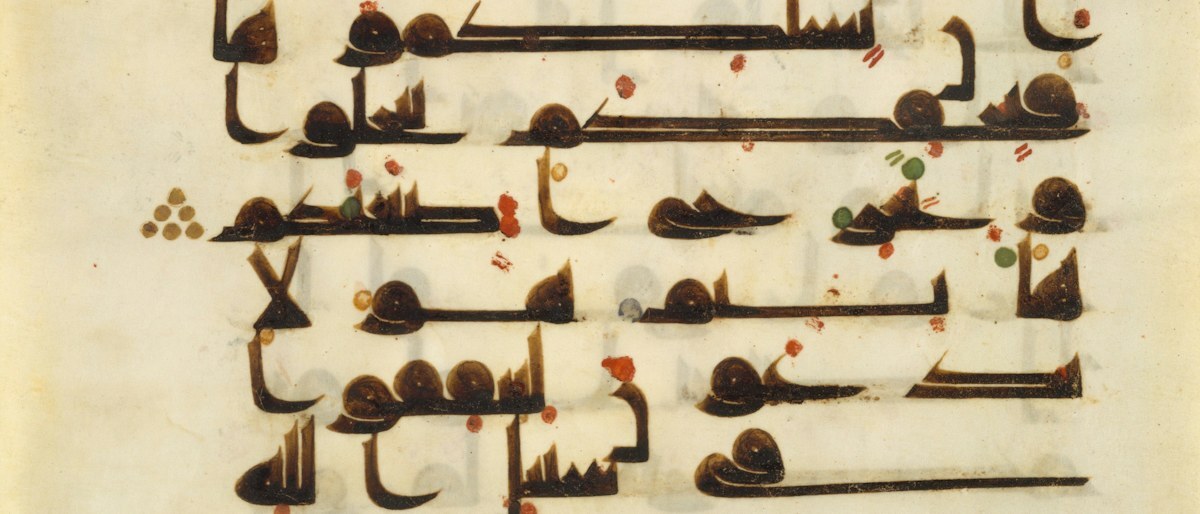
Fragments of Qur’an manuscripts survive from the first Islamic century. Several, including leaves held in Birmingham, Paris, St Petersburg, and Sana‘a, have been radiocarbon dated or palaeographically assigned to the seventh century. Their text corresponds to the Qur’an read today, with early orthographic differences and, in some cases, scribal variants.
Over the following centuries the script was refined with dots to distinguish letters and marks to indicate vowels, making the text easier to read for non-Arabs. The content these marks encode had been fixed by oral transmission.
Recognised readings
Within the single Uthmanic text, small differences in pronunciation and vocalisation were transmitted by master reciters. Scholars recognised a limited number of these readings, the qira’at, as authentic. The reading of Hafs from ‘Asim is the most widespread today; Warsh from Nafi‘ is common in North and West Africa.
These readings are not different versions of the book. They are transmitted ways of voicing one text, and Muslim scholarship documents them carefully rather than hiding them.
Memorisation today
A person who has memorised the entire Qur’an is called a hafiz. There are millions of them worldwide, including children and people who do not speak Arabic as a first language. Reciting with correct pronunciation follows rules called tajwid.
This living memory, continuous across fourteen centuries, is the heart of what Muslims mean when they say the Qur’an has been preserved. The printed page records what the community already carries.
Sources & further reading
- Qur’an 15:9 God guards the Reminder.
- Qur’an 75:16-19 The Prophet is told not to hasten; God will gather and recite it.
- Qur’an 96:1-5 The first revelation: read, in the name of your Lord.
- Encyclopaedia Britannica — Qur’an Overview of history, structure, and transmission.
- Sahih al-Bukhari 4986 Zayd ibn Thabit’s account of collecting the Qur’an.
Original introductory summary, not a direct scripture translation. Prepared 21 October 2026. Qualified human religious review is pending. About our editorial approach.