The idea in brief
The Islamic calendar is lunar, with twelve months of 29 or 30 days and a year about eleven days shorter than the solar year. It counts from the Hijrah in 622 CE. Its two festivals are Eid al-Fitr and Eid al-Adha, and other days such as Ashura and the Night of Power carry particular significance.
A lunar year
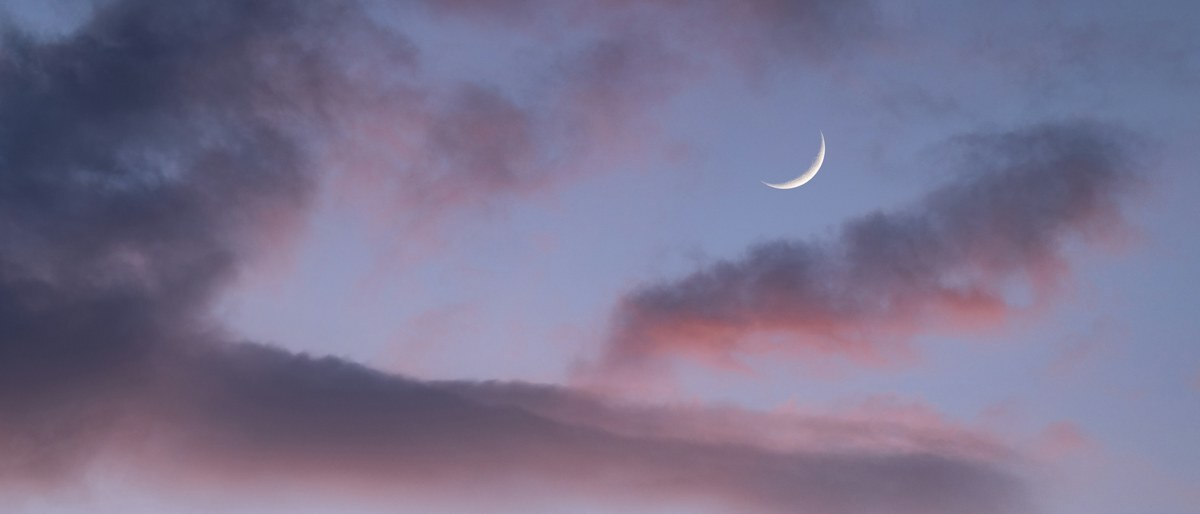
Each Islamic month begins with the new crescent moon. Qur’an 9:36 states that the number of months with God is twelve, and 2:189 says the new moons mark times for people and for pilgrimage. Because twelve lunar months are about 354 days, Islamic dates move roughly eleven days earlier each solar year.
This means Ramadan and the Hajj rotate through all the seasons over about 33 years. Years are counted AH, after the Hijrah, the migration to Medina in 622 CE.
The twelve months
The months are Muharram, Safar, Rabi‘ al-Awwal, Rabi‘ al-Thani, Jumada al-Ula, Jumada al-Akhirah, Rajab, Sha‘ban, Ramadan, Shawwal, Dhul Qa‘dah, and Dhul Hijjah. Four of them, Muharram, Rajab, Dhul Qa‘dah, and Dhul Hijjah, are called sacred months, in which fighting was traditionally forbidden.
Whether a month begins by sighting the moon locally, by sighting anywhere in the world, or by astronomical calculation is a matter on which communities differ. This is why the first day of Ramadan or Eid can fall on different days in different places.
The two Eids
Eid al-Fitr, on the first of Shawwal, celebrates the end of Ramadan with a morning prayer, charity, and festivity. Eid al-Adha, the Festival of Sacrifice, falls on the tenth of Dhul Hijjah during the Hajj and commemorates Abraham’s willingness to sacrifice his son; families who can afford it sacrifice an animal and share the meat with the poor.
Both festivals begin with a congregational prayer and a sermon and continue with visits, food, and gifts to children. They are the only two festivals established by the Prophet; both are celebrated by all Muslim traditions.
Other significant days
Ashura, the tenth of Muharram, is observed by Sunni Muslims with an optional fast and by Shia Muslims as the day of mourning for the martyrdom of Husayn at Karbala. The Night of Power falls in the last ten nights of Ramadan. Friday is the weekly day of congregational prayer.
Many Muslims mark the Prophet’s birthday, the Mawlid, on the twelfth of Rabi‘ al-Awwal with gatherings and recitation; others do not, regarding it as a later custom. The Night Journey is remembered by some on the twenty-seventh of Rajab. These observances vary by community and are not pillars of the faith.
Days with no special status
Islam has no religious observance of birthdays, New Year, or national holidays, and Muslims take various views on taking part in the celebrations of other traditions. Attitudes range from warm participation to polite abstention. Asking a particular person is better than assuming.
If you work or study with Muslims, knowing the approximate dates of Ramadan and the two Eids each year is a simple courtesy that is widely appreciated.
Sources & further reading
- Qur’an 9:36 Twelve months with God.
- Qur’an 2:189 New moons as markers of time.
- Qur’an 2:185 Ramadan and the sighting of the month.
- Sahih al-Bukhari 952 The two days of festival.
Original introductory summary, not a direct scripture translation. Prepared 21 October 2026. Qualified human religious review is pending. About our editorial approach.