The idea in brief
Hajj is the pilgrimage to Mecca performed in the month of Dhul Hijjah. It is required once in a lifetime of every Muslim who is physically and financially able. Over five or six days pilgrims circle the Ka‘bah, walk between two hills, stand in prayer on the plain of Arafat, and remember Abraham and his family.
Why Mecca
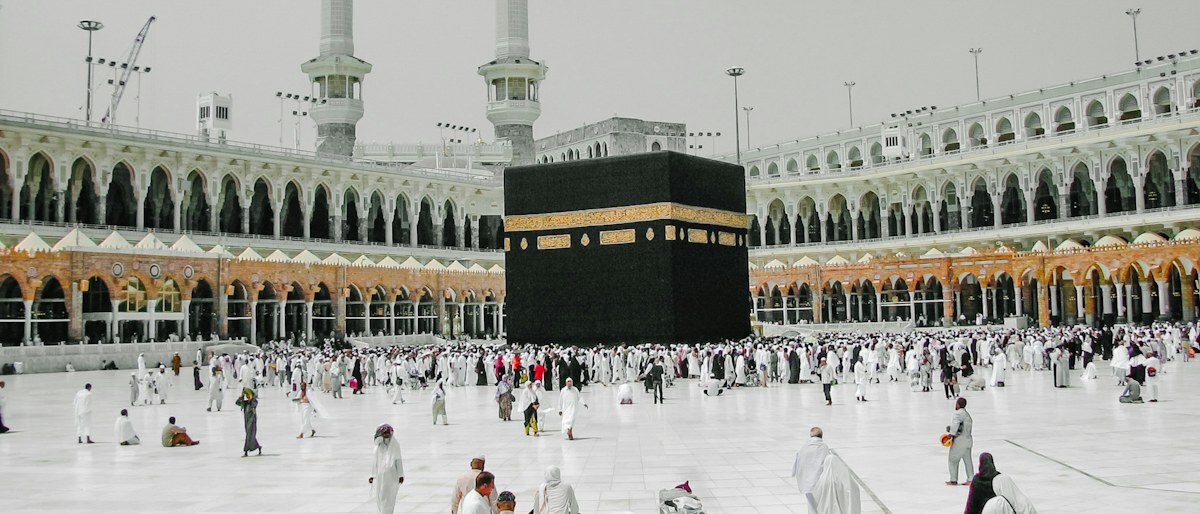
Muslims believe the Ka‘bah, the cube-shaped building at the centre of Mecca’s Grand Mosque, was built by Abraham and his son Ishmael as a house dedicated to the worship of the one God. Qur’an 2:125–127 recounts this, and 3:96–97 describes it as the first house established for humanity and makes pilgrimage a duty on those who are able.
The Ka‘bah is the direction of prayer for Muslims worldwide. It is not worshipped. Circling it is an act of worship directed to God, around the place He made a sign.
Preparing: ihram
Before entering the sacred area pilgrims enter a state called ihram. Men wear two plain white unsewn cloths; women wear simple modest clothing. In this state pilgrims avoid perfume, cutting hair or nails, arguments, and harm to living things. Kings and labourers become indistinguishable.
The chant of the pilgrim is the talbiyah: here I am, O God, here I am. It expresses the whole meaning of the journey as an answer to a call.
The days of Hajj
On the eighth of Dhul Hijjah pilgrims travel to Mina. On the ninth they stand on the plain of Arafat from noon to sunset in prayer and supplication; this standing is the heart of the pilgrimage, and tradition holds that it is where sins are forgiven. The night is spent at Muzdalifah.
On the tenth, the day of Eid al-Adha, pilgrims cast pebbles at pillars representing Satan, recalling Abraham’s rejection of temptation; offer a sacrifice, recalling the ransom of his son; cut or shave their hair; and return to Mecca to circle the Ka‘bah. Further days at Mina complete the rites.
Hagar and the running between the hills
Pilgrims walk seven times between the hills of Safa and Marwah, mentioned in Qur’an 2:158. This recalls Hagar, Ishmael’s mother, searching for water for her child in the desert until the well of Zamzam sprang up. A woman’s desperate trust is commemorated by every pilgrim.
Pilgrims drink from Zamzam, which still flows within the Grand Mosque. The rite expresses effort and reliance on God together.
What pilgrims bring home
Hajj gathers some two million people from every country, language, and class into the same dress and the same acts. Many pilgrims describe it as the most powerful experience of their lives; Malcolm X’s letter from Mecca describing people of all colours worshipping together is a famous account.
A pilgrim who has completed Hajj may be addressed as Hajji or Hajjah. ‘Umrah, a shorter pilgrimage with fewer rites, can be performed at any time of year and is not a substitute for Hajj. Muslims who are unable to go are not blamed; the obligation is conditional on ability.
Sources & further reading
- Qur’an 3:96-97 The first house and the duty of pilgrimage.
- Qur’an 2:125-127 Abraham and Ishmael raise the foundations.
- Qur’an 2:158 Safa and Marwah.
- Qur’an 22:27-28 The call to pilgrimage.
- Qur’an 2:196-197 Rules and conduct of Hajj.
Original introductory summary, not a direct scripture translation. Prepared 21 October 2026. Qualified human religious review is pending. About our editorial approach.